
Share this Post

Need help with your money or investments? Book a consultation to learn more about working together.
Why the Financial News Cycle Is Working Against You
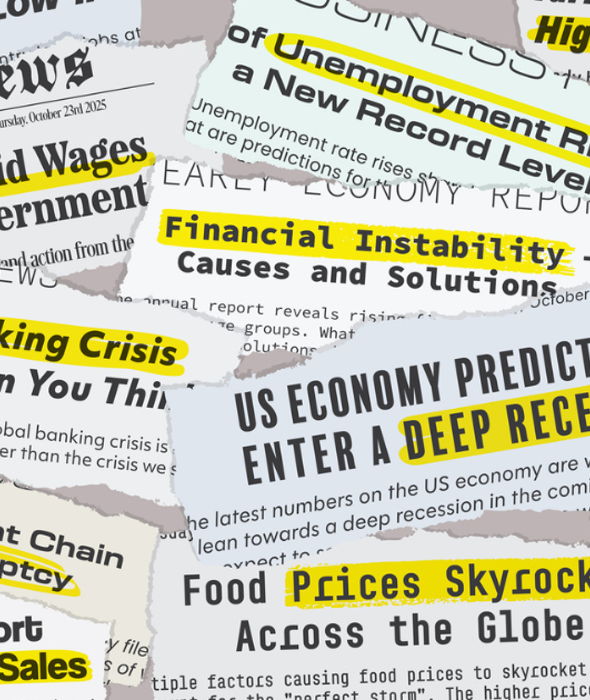
The financial news machine never stops. Market alerts hit your phone first thing in the morning. News networks run real-time tickers around the clock. Social feeds are full of hot takes on whatever moved the markets today.
It feels like staying informed.
For most long-term investors, it's really just keeping you anxious.
News Is a Business, and Its Goals Are Not Aligned With Yours
Before you can manage your relationship with financial news, it helps to understand what financial news actually is.
News organizations are businesses. Their revenue depends on keeping you engaged, and engagement is driven by urgency, drama, and fear.
Financial news channels need advertisers, advertisers want viewers, and viewers are attracted to dramatic headlines.
That means every down day risks becoming a "plunge" and every correction risks becoming a "crash."
That framing is great for ratings. It is not great for your state of mind.
Your ideal attributes as an investor (patience, consistency, long-term thinking) are almost the opposite of what financial media is built to deliver.
Once you see that tension clearly, it becomes a lot easier to stop letting the news cycle drive your financial decisions.
The Time Horizon Problem
Here is the core issue with watching financial news every day as a long-term investor: the news runs on a 24-hour clock, but your investment strategy should run on a decades-long one.
The stock market historically has a “down day” roughly half the time. That means on nearly half the days you check market news, the headlines are going to be unsettling.
But zoom out to a five-year window, and the odds of a positive return climb to around 90%. Extend the horizon further, and those odds improve even more.
Daily market news and long-term investing are simply not a good match. Trying to use one to guide the other tends to lead to decisions that hurt you.
Front-Page Risk Is Not the Same as Bottom-Line Risk
Not every scary headline is actually dangerous to your investments. Kevin Gordon, head of macro research and strategy at Schwab, draws a useful line between what he calls front-page risk and bottom-line risk.
Front-page risk is a headline that shakes the market for a day or a week. Bottom-line risk is whether that headline actually affects corporate earnings over the long run.
Most front-page stories never turn into bottom-line stories. Geopolitical events, political drama, and central bank speculation all create a lot of noise. But if they don't affect the long-term earning power of the companies you own, the market reaction usually fades.
A good example is what happened in 2022. Energy stocks became the hot trade, driven by the Russia-Ukraine conflict and soaring oil prices. Many investors responded to that narrative and sold their technology holdings.
But the underlying story for technology (structural, decades-long growth driven by the digital economy) had not changed. Those who stayed the course were rewarded. Those who chased the headline were not.
The loudest story at any given moment is rarely the most important one for your investments.
The Real Cost of Reacting
The danger of too much financial news is not just stress, though that is real. The bigger danger is what that stress leads you to do.
Research from Dalbar, Inc., a firm that studies investor behavior, has found that the average investor consistently underperforms the broader market. The culprit is usually emotional reaction. When markets drop, people sell out of fear, then wait until prices have already recovered before getting back in.
Over the past two decades, every dollar invested in the S&P 500 grew more than eightfold. But miss just the ten best days during that stretch, and you would have earned less than half that return.
Ten days. Out of roughly 5,000 trading sessions over 20 years.
According to research from J.P. Morgan, investors who stayed fully invested in the S&P 500 over a 20-year period grew their portfolios substantially, while those who tried to time the market based on news events consistently fell behind.
To make it worse, many of the market's best days happened during its scariest headlines. The investors who moved to cash when things felt unbearable were often the ones who missed the recovery entirely.
Social Media Makes This Even Harder
If mainstream financial news carries risk, social media carries more.
A 2023 survey by the insurer Nationwide found that 34% of investors between the ages of 18 and 54 had acted on financial information from social media that turned out to be factually wrong or misleading.
Social platforms are built to generate strong reactions. In financial contexts, that usually means fear, excitement, or outrage – none of which are useful when making investment decisions.
If your market signals are coming from your social feed, that is worth changing.
How to Actually Manage Your News Intake
None of this means going completely dark on financial news. Staying broadly informed has real value.
What it does mean is being more intentional about how you consume it. A few things that help:
- Keep the front page out of your investment process. Any story that genuinely matters to your portfolio will show up in business and financial reporting soon enough. You do not need to be monitoring every major news outlet to stay in the loop.
- Put yourself on a media diet. Only you can control the quality and quantity of media you consume. Avoid the temptation to doom-scroll every piece of news that claims to have a definitive answer on where things are headed.
- Ask the right question. When a headline worries you, ask whether it is likely to affect the long-term earning power of the companies you own. If the honest answer is probably not, you have your answer.
- Call your advisor before you make a move. When something feels serious enough to act on, that is exactly the right time to pick up the phone rather than make a trade.
Don't Swing Too Far the Other Way
There is one important thing to keep in mind here.
Tuning out the noise does not mean assuming everything is always fine. The stock market does go down, sometimes significantly and for a long time.
Bad years happen, and they are a normal part of investing. Investors should avoid making emotional decisions based on short-term conditions in either direction, not just when the news is scary, but also when the market feels invincible.
The goal is balance. Long-term conviction paired with honest awareness that markets are not a one-way street.
What Actually Moves the Needle
The most important investment decisions you make are often the ones you choose not to make.
Staying invested when the news feels alarming. Not selling in March 2020. Not chasing the hot trade because everyone on social media was talking about it.
The keys to long-term investing success are discipline and consistency, such as fighting the urge to sell when everyone else is selling. And staying the course when the market gets uncomfortable.
That is not a passive approach. It takes real resolve. But it is a far better use of your energy than refreshing market headlines every hour looking for certainty that the news cycle was never designed to give you.
Frequently Asked Questions
How much financial news should I actually be consuming as an investor?
There is no magic number, but the general rule is to consume less than you think you need. Checking in on broad market conditions once or twice a week is plenty for most long-term investors, but even that can be too much if you're prone to being nervous about market conditions.
It's perfectly acceptable to rarely pay attention to headlines. The goal is to stay broadly informed without letting daily headlines drive your decision-making.
Is it ever appropriate to make a portfolio change based on the news?
Maybe, but it should be rare and deliberate. The key question to ask is whether the news in question is likely to affect the long-term earning power of the companies or funds you own. If the honest answer is no, it probably does not warrant a change. When in doubt, talk to your financial advisor before making any moves.
What is the difference between front-page risk and bottom-line risk?
Front-page risk is the kind of news that rattles markets in the short term: geopolitical events, political headlines, and central bank speculation. Bottom-line risk is whether that news actually affects corporate earnings in a lasting way.
Most front-page stories never become bottom-line stories, which is why market reactions to them tend to be short-lived.
Why do investors consistently underperform the market?
Research from Dalbar, Inc. has shown that emotional decision-making is the primary culprit. Investors tend to sell when markets drop out of fear and wait until prices have already recovered before getting back in. This pattern of buying high and selling low quietly erodes long-term returns over time.
How much does missing a few good market days really matter?
More than most people realize. Over the past two decades, missing just the ten best trading days in the S&P 500 would have cut your returns by more than half. The tricky part is that many of those best days happened during the most unsettling periods in the market, which is exactly when nervous investors are most tempted to sit on the sidelines.
Is social media a reliable source of financial information?
Generally, no. A 2023 survey by Nationwide found that more than a third of younger investors had acted on financial information from social media that turned out to be inaccurate or misleading. Social platforms are built to generate strong reactions, not sound financial guidance. It is best to treat social media financial content with a high degree of skepticism.
What should I do when the market drops and I feel the urge to act?
The best first move is usually to call your financial advisor rather than make a trade. Having a trusted advisor to talk through your concerns with can be the difference between a reactive decision you regret and a deliberate one you feel good about. In many cases, the right answer is simply to stay the course.